A finished kilt may look simple: a flat front, neatly arranged pleats at the back, and a natural swing as the wearer moves. However, the amount of fabric needed to create that shape is often where confusion begins. You may hear that a kilt requires 8 yards of tartan, while someone else may mention 5 yards. You may also be told that the amount depends on the width of the fabric.
That last answer is the most accurate.
The amount of tartan required depends on several factors, including the kilt style, the wearer’s measurements, pleating style, tartan sett and fabric width. Even so, most adult kilts generally fall within a fairly clear range.
A traditional kilt commonly uses around 8 yards of tartan, while a lighter casual kilt may use approximately 5 yards. Understanding these differences can help you choose the right amount of fabric before ordering or making a kilt.
What Is the Usual Amount of Tartan for a Kilt?
For a traditional men's kilt, 8 yards is the figure most commonly associated with a full kilt.
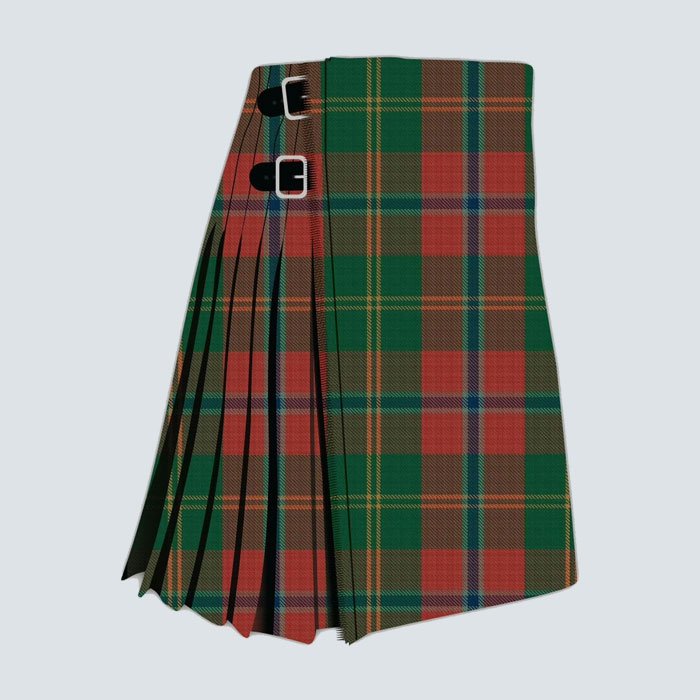
A traditional kilt requires enough tartan to create the front aprons, overlap, seat, hip area and back pleats. Although the front of the kilt may appear relatively flat, a significant amount of fabric is concentrated in the pleated back.
This additional fabric gives the kilt its characteristic weight and structure. It allows the pleats to sit correctly and creates the traditional appearance associated with weddings, formal occasions, Highland events and other special gatherings.
A 5-yard kilt takes a slightly different approach. It can still provide the recognizable appearance of a kilt while using less fabric. Because there is less material available for the pleats, the finished garment is generally lighter and may have a softer swing.
This style can be suitable for casual wear, festivals, summer events and everyday occasions where comfort and lighter weight are important.
Why Does Fabric Width Affect the Amount of Tartan Needed?
One of the main reasons you may see different fabric requirements is that tartan is not always produced at the same width.
Some tartan fabrics are woven as single-width fabric, while others are available in double-width fabric. A wider fabric provides more material across the roll, which can affect how much yardage is required for the finished garment.
For this reason, it is not always appropriate to copy the fabric requirement from another kilt.
Two kilts may both be described as traditional, yet require different amounts of fabric because the fabric width, tartan sett or construction is different. The size of the tartan pattern can also influence the cutting process. Larger setts may require additional attention to ensure the pattern lines up correctly across the aprons and pleats.
Do Your Measurements Affect the Amount of Tartan?
Yes. The wearer's measurements play an important role in determining how much fabric is required.
Waist size is particularly important because a kilt wraps around the body and overlaps at the front. The remaining fabric must then provide enough material for the pleats at the back. A larger waist measurement may therefore require additional fabric to maintain the desired fullness.
Length also matters. A taller wearer may require a longer kilt, meaning the fabric must provide enough vertical length from the waist to the desired hemline.
Before ordering a kilt, it is helpful to have your key measurements ready, including:
Having accurate measurements helps the maker create a kilt that fits comfortably without becoming too tight, too short or lacking sufficient fullness at the back.
How Do Pleats Affect Tartan Requirements?
Pleats are one of the main reasons a kilt requires more fabric than its finished appearance might suggest.
Without pleats, a kilt would lose much of its characteristic movement, structure and shape. The additional fabric is folded into the back to create the distinctive pleated appearance and natural swing associated with a traditional kilt.
There are two common approaches to pleating:
Pleated to the Sett
With pleating to the sett, the tartan pattern is arranged so that the design continues across the pleats. This creates a coordinated appearance and places emphasis on the overall tartan pattern.
Pleated to the Stripe
With pleating to the stripe, a particular stripe or line in the tartan becomes the main visual feature across the back.
Neither approach is inherently better than the other. They simply create different visual effects and may require different levels of pattern matching during construction.
Because pleating affects both the appearance and fabric usage, it is worth discussing your preferred pleating style before purchasing your tartan.
Is 5 Yards Enough for a Kilt?
For some casual kilt styles, 5 yards can be enough.
A 5-yard kilt can be lighter and comfortable for extended wear. It may be a practical choice for festivals, casual gatherings, summer occasions and everyday outfits where a lighter garment is preferred.
However, if you want a fuller, more traditional appearance for a wedding, formal Highland dress or another special occasion, an 8-yard kilt may be more suitable.
The additional fabric provides greater scope for creating deeper, fuller pleats and a more substantial traditional appearance.
5 Yards vs. 8 Yards: What's the Difference?
The difference is not simply the amount of fabric. It can also affect the overall character of the finished kilt.
Around 5 yards:
Generally lighter
Suitable for many casual applications
Can provide a softer swing
Often practical for everyday wear
Uses less fabric
Around 8 yards:
Fuller and more substantial
Provides more fabric for pleating
Commonly associated with traditional kilts
Suitable for formal and ceremonial occasions
Allows greater flexibility in creating traditional pleat arrangements
The right choice ultimately depends on the wearer, the kilt design, the fabric and the intended occasion.
Conclusion
There is no single amount of tartan that works for every kilt.
A traditional adult kilt commonly uses around 8 yards of tartan, while many lighter or casual styles can be made with around 5 yards. However, the final amount depends on factors such as fabric width, waist and hip measurements, kilt length, tartan sett, pleating style and the desired finished appearance.
Rather than choosing a fabric quantity based on a single number, it is better to consider the complete kilt design and the wearer's measurements before ordering.
For those looking for a traditional appearance, exploring different men's tartan kilts can also help you understand how fabric quantity, pleating and tartan patterns affect the finished look.
The goal is to use enough tartan to create a well-balanced kilt with properly formed pleats, a comfortable fit and a clean, traditional appearance.
If you want, I can also make this version more SEO-focused for the US Kilt Store, including a meta title, meta description, H1/H2 structure, target keywords, and internal-link placements.


 James OF Wales Tartan Kilt
 Ross Hunting Ancient Tartan Kilt
 Macleod Hebridean Tartan Kilt
 Aberdeen Tartan Kilt